Computer Vision Systems Architecture
Eliminating CPU memory bottlenecks and network latency through hardware NVDEC decoding, fused CUDA kernels, INT8 quantization, and decentralized edge micro-inferencing.
The 8-Stage Inference Pipeline
Zero-Memory-Copy Accelerated Architecture
Computer Vision Pipeline
Extracts high-dimensional spatial feature representations across industrial machinery, workers, gear, vehicles, and hazardous boundaries.
- Dual-backbone feature pyramid networks for micro-object detection
- Pose keypoint extraction for ergonomics and slip-and-fall alarms
- Multi-head classification for sub-category asset discrimination
Zero-Memory-Copy Ingestion
Conventional video pipelines decode frames into host CPU RAM, then copy them over the PCIe bus into GPU memory. Genovaxai DeepStream integration binds hardware NVDEC directly to GPU memory pointers, saving 4-8ms of latency per frame.
INT8 Layer Fusion Engine
Using NVIDIA TensorRT, our trained PyTorch weights undergo post-training quantization with entropy calibration. Adjacent convolution, batch normalization, and activation layers are fused into unified hardware execution kernels.
Multi-Camera Spatial Re-ID
When objects pass behind pillars or traverse disparate camera viewpoints, our Re-ID deep embedding network maintains consistent spatial identity IDs, calculating directional speed and zone dwell time accurately.
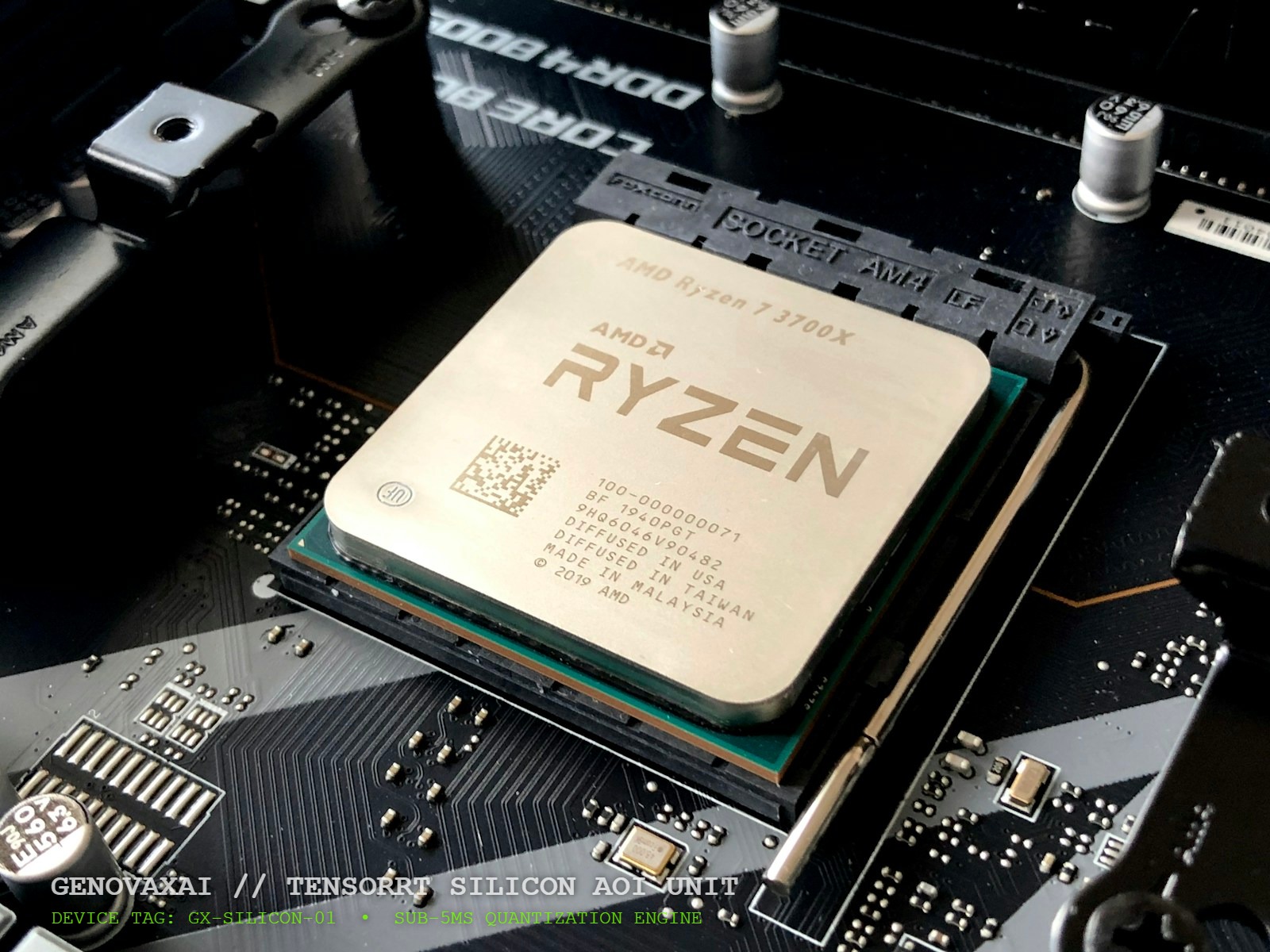
Hardware Acceleration in Action